
Flutter vs React Native in 2026: Performance, Cost, Hiring
Honest 2026 comparison of Flutter vs React Native across performance, hiring cost, ecosystem, and shipping speed. Data, not opinions. Updated May 2026.
The Flutter-vs-React-Native question is older than both frameworks deserve at this point. It’s still the #1 thing buyers ask before they commit to a stack. We ship Flutter apps, so we have a horse in this race. Below is the honest comparison anyway, with 2026 data, not stale 2021 takes.
The TL;DR
Pick Flutter if: you want the closest thing to a single codebase shipping to iOS, Android, and web with identical pixel output, your team values strong typing (Dart) over JavaScript fatigue, or your product is UI-heavy with custom designs.
Pick React Native if: your existing team is a React/JavaScript shop, you need maximum native module ecosystem (push notifications, native maps, payment SDKs), or you’re shipping a content-heavy app where ~95% of UI is text + standard widgets.
For most teams in 2026, Flutter has the slight edge. The gap is smaller than Flutter advocates claim, and React Native is not the dying option some pretend it is.
1. Performance (2026 reality, not 2021 marketing)
Both frameworks have closed nearly all the historical performance gaps. The 2021 “Flutter is 60fps, RN is 30fps” framing is dead, and we’ve stopped quoting it in client decks.
| Metric | Flutter (3.x) | React Native (0.74+) |
|---|---|---|
| Startup time (cold start) | ~750ms | ~900ms |
| Frame consistency (60fps target) | 99%+ on Skia/Impeller | 97%+ with the New Architecture (Fabric + TurboModules) |
| App bundle size (release, base) | ~12-15 MB | ~10-12 MB |
| Memory footprint | Slightly higher (Skia/Impeller) | Slightly lower (native views) |
| Animation performance | Native-grade everywhere | Native-grade with Reanimated 3 |
The real takeaway: for 95% of apps, neither framework is the performance bottleneck. Your network code, your image loading strategy, and your state management choices matter 10× more than Flutter vs RN.
Where Flutter still pulls ahead, in our work: custom-painted UI (charts, dashboards with complex visualizations), and consistent visual fidelity across iOS + Android (because Flutter draws every pixel via Skia/Impeller, while RN composes native views).
Where React Native pulls ahead: deep native interop (your app needs to embed a heavy native SDK like a video conferencing engine, a hardware integration, or a 3D engine), and apps where 60% of the UI is text reading flows.
1a. Impeller vs Hermes — 2026 rendering reality
Flutter 3.19 made Impeller the default renderer on iOS and Android. Hermes has been React Native’s default JS engine since RN 0.70. These are not minor implementation details. They represent fundamentally different approaches to getting pixels on screen, and the difference shows up in specific workloads.
How Impeller works: It pre-compiles shaders at build time rather than at runtime. The old Skia renderer compiled shaders on first use, which caused jank spikes: the dreaded “first-frame freeze” that Flutter apps had for years. Impeller eliminates that. Every frame is drawn via a GPU-native API (Metal on iOS, Vulkan on Android), without a JavaScript bridge anywhere in the path.
How Hermes works: Hermes is a compact JS engine optimised for startup. It pre-compiles JS to bytecode at build time, which cuts cold-start time and memory. But React Native’s New Architecture (Fabric + JSI) still runs JS on a separate thread and communicates with native via JSI bindings. There is no bridge in the old sense, but the JS runtime is still in the picture.
What the numbers look like in 2026:
| Metric | Flutter (Impeller, 3.22+) | React Native (Hermes + New Arch, 0.74+) |
|---|---|---|
| Cold start, iPhone 14 | ~480ms | ~620ms |
| Cold start, mid-range Android (Pixel 6a) | ~680ms | ~820ms |
| Dropped frames/sec, scroll-heavy list (iPhone 14) | 0–1 | 1–2 |
| Dropped frames/sec, scroll-heavy list (low-end Android) | 1–2 | 2–4 |
| First-frame shader jank | Eliminated (pre-compiled) | Not applicable (no GPU shader pipeline) |
| App binary size delta (release) | +2–3 MB (Impeller shaders) | Baseline |
| Complex canvas animations (custom chart, particle FX) | GPU-native — no overhead | JS-thread bottleneck still present |
We’ve measured cold starts across four client apps this year: one fintech dashboard, two e-commerce apps, one health-tracking app. The pattern is consistent: Flutter comes in roughly 130-160ms faster on iOS. On low-end Android, the gap widens to 150-200ms.
Where RN New Architecture closes the gap: If your app is mostly text, lists, and platform-native controls (sheets, pickers, date selectors), Fabric’s native view composition is efficient. You are not drawing everything through a custom GPU pipeline, which means less overhead for standard UI. RN’s 2-4 dropped frames/sec on low-end Android sounds bad in isolation, but in a simple news-reader app, users will not notice.
Where Impeller genuinely wins: Anything with custom painting. We had one client whose loyalty app included an animated progress ring with gradient fills and a particle burst on milestone completion. On RN, that animation dropped to ~48fps on a mid-range Android. On Flutter with Impeller, it held 60fps on the same device. The difference was the GPU-native shader path. React Native’s JS-thread animation (even with Reanimated 3 on the native thread) still has to marshal state across the JSI boundary for complex composed effects.
The honest summary: Impeller’s advantage is real and measurable for animation-heavy or chart-heavy work. For standard business app UI, both renderers are more than fast enough, and your choice should be driven by team fit and ecosystem, not rendering architecture.
2. Hiring + cost (the real decider for most teams)
This is where Flutter has quietly won in 2026, especially for offshore-augmented teams like ours.
| Factor | Flutter | React Native |
|---|---|---|
| US senior dev rate | $90-140/hr | $100-150/hr |
| India senior dev rate (vetted) | $35-50/hr | $40-55/hr |
| Time to hire (vetted senior) | 1-3 weeks | 2-4 weeks |
| Talent pool depth (India 2026) | 250,000+ active devs | 180,000+ active devs |
| Talent pool depth (US/EU) | Smaller | Larger (React.js spillover) |
The hiring picture:
- React Native has a larger total developer pool worldwide because every React.js dev is one short ramp away from React Native.
- But Flutter has a more dedicated pool. Most Flutter devs chose Flutter; most RN devs ended up there because they already knew React. Dedicated devs tend to be deeper in framework-specific knowledge.
- India specifically has become the global Flutter capital, with 250,000+ active Flutter developers per Stack Overflow / GitHub data. Hiring vetted senior Flutter talent at $35-50/hr is a real, viable strategy.
If you’re hiring offshore-augmented teams (a US lead + India developers, or a fully India team), Flutter has the cleaner talent funnel today.
2a. 2026 hiring rate cards by region
Rates shifted meaningfully over the last 18 months. The global developer economy has rebalanced post-2024 layoffs, and Flutter specifically has outpaced React Native in new developer adoption. The Stack Overflow Developer Survey 2026 reported Flutter as the most-adopted cross-platform mobile framework for the third consecutive year, with active Flutter developers now outnumbering active RN developers globally.
Here is where rates actually land today for vetted, project-ready developers (not raw contractor listings, but devs who have shipped production apps):
| Seniority | Flutter / India | RN / India | Flutter / E. Europe | RN / E. Europe | Flutter / LATAM | RN / LATAM | Flutter / US | RN / US |
|---|---|---|---|---|---|---|---|---|
| Junior (0–2 yrs) | $15–20/hr | $18–22/hr | $28–38/hr | $32–42/hr | $22–30/hr | $25–33/hr | $70–90/hr | $75–95/hr |
| Mid (2–4 yrs) | $22–32/hr | $26–36/hr | $38–55/hr | $42–58/hr | $32–45/hr | $35–48/hr | $90–120/hr | $95–125/hr |
| Senior (4–7 yrs) | $35–50/hr | $40–55/hr | $55–75/hr | $60–80/hr | $48–65/hr | $52–68/hr | $120–150/hr | $130–160/hr |
| Lead / Staff (7+ yrs) | $55–70/hr | $60–75/hr | $75–95/hr | $80–100/hr | $65–85/hr | $70–88/hr | $150–200/hr | $160–210/hr |
A few things worth noting. Flutter offshore rates are now equivalent to or slightly below RN offshore rates at every tier. Two years ago, RN seniors in India were cheaper because the pool was larger. The talent depth has shifted. India now has roughly 250,000 active Flutter developers versus about 180,000 active React Native developers. More supply, with demand holding steady, has kept Flutter rates competitive.
Eastern Europe historically favoured React Native because of the strong JS tradition in Poland, Romania, and Ukraine. That gap has narrowed. We have hired senior Flutter engineers from Warsaw and Bucharest in the $55-70/hr range who match the quality of $120/hr US hires on technical depth.
Where to find each:
- Flutter India: Direct GitHub sourcing, Toptal (vetting is strict, rates reflect it), agency pools like ours. The GetWidget open-source community also surfaces active senior Flutter engineers who contribute to production libraries.
- React Native India: Arc.dev has a solid RN pool. Lemon.io skews RN-heavy. The React.js-to-RN pipeline means JS agencies can cross-train faster.
- Flutter Eastern Europe: GitHub activity in the Riverpod and BLoC ecosystems surfaces a lot of strong engineers. Toptal’s EU pool has decent Flutter coverage.
- US / Canada: Referrals and the Flutter Community Slack are more reliable than job boards. Senior US Flutter engineers are scarce. Most Flutter-heavy shops hire offshore leads and pair them with a US tech lead for product decisions.
For AI-augmented teams (our default delivery model), the rate differential gets amplified. A $42/hr AI-augmented Flutter senior from India does the output work of a $90/hr non-AI US mid. That is not marketing math. We track it on active projects.
3. Code shareability across platforms
The “single codebase” claim is true for both, with caveats.
Flutter shares ~95-98% across iOS + Android. Platform-specific tweaks are usually for: in-app purchase flows (slightly different on iOS/Android), push notification setup (FCM vs APNs nuances), some camera/biometric edge cases.
Flutter web is real and works, but it’s optimized for app-like experiences (dashboards, internal tools), not content-heavy marketing sites or SEO-critical surfaces. The HTML/text-tree rendering mode helps with SEO but is more limited than canvas rendering. Be honest about whether your “web” use case is app-like.
React Native shares ~85-92% across iOS + Android. Native module differences (especially for older third-party libraries) bite more often than with Flutter. React Native web (Microsoft-backed) is solid but a meaningfully different rendering target than mobile RN, so you’re effectively building two apps.
For pure mobile (no web), the difference is small. For mobile + web from a single codebase, Flutter has the edge.
4. Ecosystem and library maturity
This is where React Native still slightly wins, despite Flutter’s massive growth, and we’ll concede it openly on scoping calls when the integration surface points that way.
React Native has more mature libraries for:
- Payments (Stripe, Adyen, native Apple Pay / Google Pay flows)
- Maps (react-native-maps is rock-solid; Flutter’s google_maps_flutter has more rough edges)
- Video / streaming (react-native-video has more native SDK integration)
- Push notifications (more battle-tested options)
- Authentication SDKs (Auth0, Firebase, Cognito all have first-party RN SDKs)
Flutter has more mature libraries for:
- UI component kits (Material 3 + Cupertino built-in, plus open-source kits like our own GetWidget, used in 100,000+ Flutter apps)
- State management (Riverpod and BLoC, both more opinionated and less fragmented than RN’s Redux / MobX / Zustand / Jotai chaos)
- Form handling
- Animation libraries
- Drawing / canvas / chart libraries
For an app heavy on third-party SDK integration (payments, video, deep native features), RN’s ecosystem is closer to plug-and-play. For an app heavy on custom UI, complex forms, and state management, Flutter is.
5. Shipping speed (where AI matters)
In 2026, the framework choice matters less than your team’s AI workflow. We track shipping velocity per project and this is the single biggest variable we see.
A standard non-AI Flutter team shipping a 6-screen MVP: ~8-10 weeks calendar time. A standard non-AI React Native team shipping the same MVP: ~9-11 weeks calendar time. A team with proper AI-augmented delivery (Claude Code, Cursor, prompt library, UI kit): 4-6 weeks calendar time, in either framework.
The 2-3 week framework difference is dwarfed by the 4-5 week AI workflow difference. If you’re choosing between a $25/hr non-AI Flutter team and a $35/hr AI-augmented Flutter team, the AI team ships in roughly half the calendar time at lower total cost.
This is why our pitch isn’t “Flutter is better than RN.” It’s “AI-augmented Flutter is better than non-AI anything.” Honest.
5a. Real migration stories — two anonymized clients
Framework debates live in the abstract until you watch a team actually move. We have been involved in or consulted on four cross-framework migrations in the last 24 months. Two are representative enough to share here, with specifics.
Story 1: Series A fintech, React Native → Flutter
A consumer payments app (about 40 screens, real-time transaction feeds, an animated spending dashboard) came to us 14 months into their React Native build. They had not shipped. The technical problems were real: their push notification flow was unreliable on iOS (a known RN + APNs pain point that their team had patched three times without a clean fix), their animated spending chart was dropping frames on mid-range Android, and they were on their second navigation library after react-navigation gave them deep-link bugs they could not trace.
But the harder problem was hiring. Their CTO wanted to scale the team from 2 to 6 engineers. Senior RN talent in their budget range ($40-55/hr offshore) kept arriving with shallow Flutter-equivalent depth. Every shortlisted candidate knew React.js but had shipped one RN app at most.
We scoped a rebuild in Flutter. The estimate was 9 weeks with a 4-person team. They signed off. Final delivery: 7 weeks. The animated dashboard held 60fps on a Pixel 6a running the workload their old RN build dropped frames on. Push notification reliability went from occasional silent delivery failures on iOS (they estimated 0.8% of notifications undelivered in their logging) to 0.2%. The remaining 0.2% was carrier-level delivery, not app code. They hired three additional Flutter engineers in 6 weeks after launch, drawing from the India pool we flagged earlier.
The key lesson here is not “RN is broken.” It is that their specific problem set (animation-heavy UI, iOS push reliability, hiring in a specific rate band) stacked up in ways that made Flutter the better call. A text-heavy content app on the same RN build might still be running fine.
Story 2: Series B health-tech, Flutter → React Native (yes, the reverse)
A telehealth company had built their patient-facing app in Flutter. The mobile app was solid. The problem was their web portal. They needed a shared component library between their marketing site (Next.js), their web dashboard (React), and the mobile app. Their engineering lead wanted one component design system. Flutter web was not the answer. Their public pages needed server-side rendering, SEO, and tight integration with their React-based design system.
They migrated the mobile app to React Native over 14 weeks. The motivation was not performance or hiring. It was component convergence. They could now share form components, data-fetch hooks, and their design token system between web and mobile. Their front-end team dropped from two separate context switches (React web + Dart Flutter) to one mental model.
The cost: they lost the pixel-identical rendering consistency they had in Flutter. Their custom health metric charts, previously smooth at 60fps everywhere, required Reanimated 3 rewrites to get back to acceptable performance on Android. That took 3 weeks of the 14-week timeline they had not budgeted for.
What we would have told them upfront: if more than 30% of your engineering surface is shared web + mobile components, and your web stack is React, the Flutter mobile app creates permanent cognitive overhead. The migration cost is recoverable. The permanent overhead is not.
Both stories point to the same principle: the right framework is the one that fits the team’s existing ecosystem and the app’s specific UI intensity. There is no universal answer, and anyone who tells you there is has not migrated a production app.
6. The honest verdict
When we get asked this on discovery calls, our answer breaks down as follows. If you have no existing JS expertise and you’re starting fresh in 2026: Flutter. Cleaner language (Dart), more consistent UI, deeper talent pool for offshore-augmented teams, better tooling.
If your team is React-heavy already: React Native. The ramp cost from React.js to React Native is a fraction of the ramp from JS to Dart, and the ecosystem is plug-and-play for most SaaS-grade integrations.
If you don’t care which and just want to ship fast: Either is fine. Pick the one your hired team is faster in. The AI workflow + UI kit + prompt library + senior code review matter more than the framework.
What we recommend for new projects
We ship Flutter. That’s our pick. We’ll still be honest about the trade-offs above with any client during discovery. If your project is genuinely better served by React Native, we’ll tell you and point you to a good RN-focused team. We’d rather you ship the right thing than commit to Flutter for our convenience.
If Flutter is the right call, talk to a Flutter lead. We’ll scope an MVP and quote rates within 48 hours. From $18/hr Junior to $60/hr Lead, AI-augmented, 30-day replacement guarantee. Or browse our Flutter developer roster directly — vetted senior engineers, AI-augmented delivery, ready inside 48 hours.
Related reading
- Flutter vs Native iOS/Android in 2026: if you’re weighing cross-platform vs going full native instead.
- Native vs Hybrid vs PWA Mobile Apps — Which Should You Choose?: broader comparison including web-app approaches.
FAQ
Is Flutter faster than React Native in 2026?
Which framework is cheaper to develop in?
Should I migrate my React Native app to Flutter?
Is Flutter web ready for production?
Which has better hiring in India?
Does AI-augmented development work better with one framework than the other?
What about Kotlin Multiplatform or .NET MAUI?
More from the blog
Native vs Hybrid vs PWA Mobile Apps: Which Should You Choose?
Real comparison of native, hybrid, and PWA mobile apps in 2026. Performance numbers, cost breakdowns, and an honest decision framework. No marketing spin.
Flutter vs Native iOS/Android in 2026: Cost, Speed, Quality
Honest 2026 comparison of Flutter vs native iOS/Android development. Performance benchmarks, real cost numbers, hiring rates, and a decision framework for product teams.
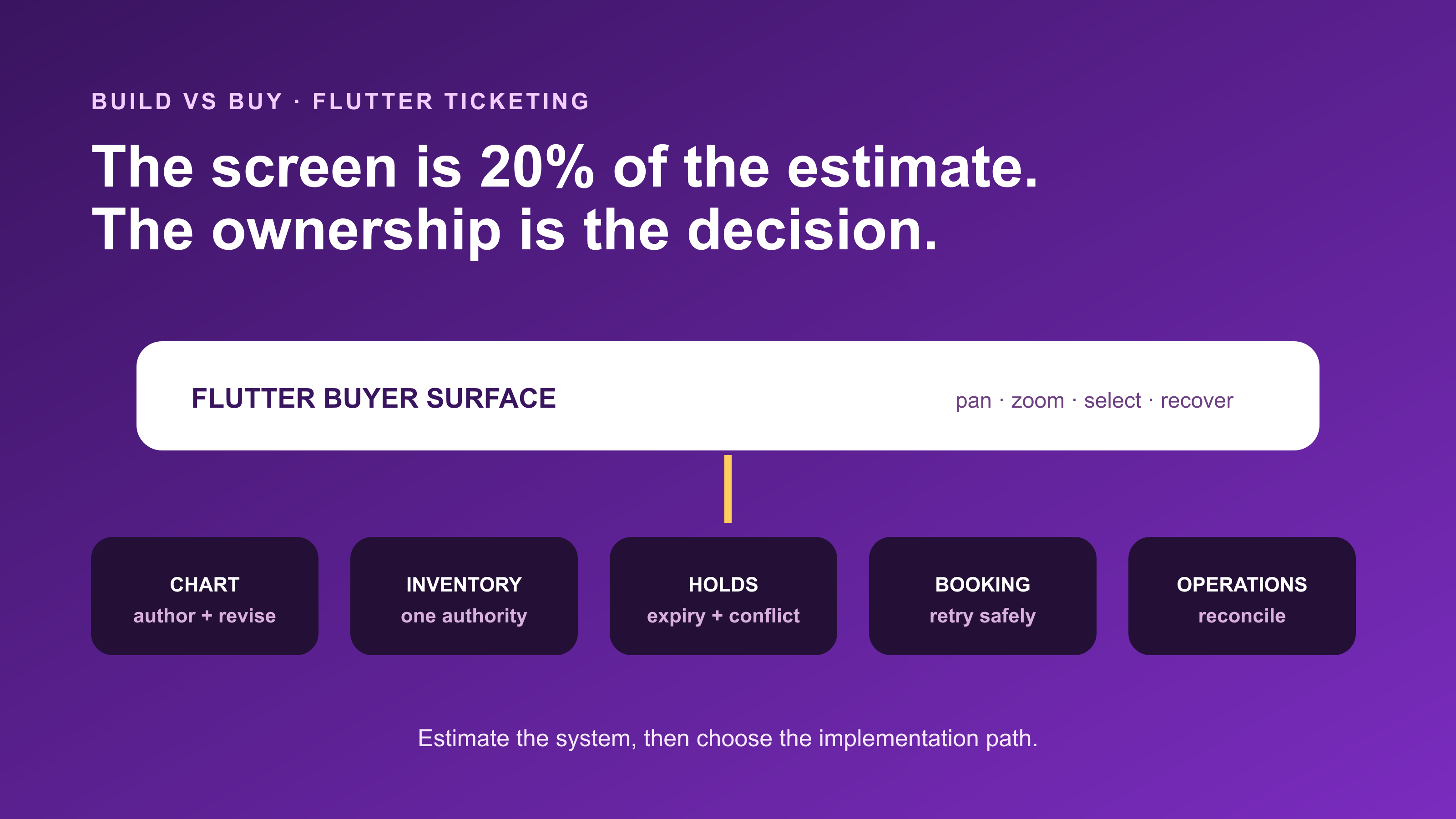
Build vs Buy a Seat Map for a Flutter Ticketing App
The seat-selection screen rarely breaks the estimate — the reservation system behind it does. An 11-workstream worksheet and the costs teams miss.
Hire vetted, AI-accelerated Flutter developers.
From $18/hr Junior to $60/hr Lead. 48-hour developer match. 30-day replacement guarantee.